
Kinetic vs Automatic Watches: What's the Difference?
If you've been shopping for a watch lately, you've probably seen the word "kinetic" used in a couple of different ways — and it's easy to come away a little confused about what it actually means. Here's a simple, plain-English breakdown of what a kinetic watch is, how it differs from an automatic watch, and why the two get mixed up so often.
The Short Answer
A kinetic watch uses the movement of your wrist to generate a small amount of electricity, which then powers a normal battery-style quartz movement inside.
An automatic watch also uses the movement of your wrist — but instead of making electricity, it winds up a small mechanical spring, the same way a wind-up clock works. No batteries, no electronics, just gears and springs.
They both start the same way — your arm's swing spins a small, weighted disc inside the watch. From there, the two technologies handle that energy completely differently.
Kinetic vs Automatic: Side by Side
| Feature | Automatic Watch | Kinetic Watch |
|---|---|---|
| What's inside | Purely mechanical — gears and springs | Electronic — a tiny generator and circuit |
| How energy is stored | Winds a small coiled spring | Charges a small rechargeable battery |
| What keeps time | A swinging balance wheel | A quartz crystal, same as a regular battery watch |
| How long it runs unworn | Around 1 to 2 days | Up to several months on a full charge |
| Accuracy | A few seconds per day | A few seconds per month |
| Second hand | Glides smoothly around the dial | Ticks once per second, like a normal battery watch |
How a Kinetic Watch Actually Works
It's a clever bit of engineering once you break it down into simple steps:
- As you move your arm, a small weighted disc inside the watch spins.
- That spinning disc drives a tiny built-in generator, a bit like a miniature dynamo on a bicycle.
- The generator creates a small amount of electricity, which charges a tiny rechargeable battery inside the watch.
- That stored electricity powers a quartz crystal, which is what actually keeps time — the exact same technology used in a regular battery watch.
So while it looks and feels like an automatic watch on your wrist, what's happening inside is really an electronic battery-powered watch that recharges itself, rather than a mechanical watch in the traditional sense.
Why Does the Name Cause Confusion?
"Kinetic" is a trademark of Seiko, which developed and popularised this technology in the late 1980s. Because Seiko's branding was so successful, many people now use the term "kinetic" loosely to describe any watch powered by the motion of your wrist — including true mechanical automatic watches, which work in a completely different way.
Other brands that make similar hybrid systems often call it "autoquartz" or "automatic quartz" instead to avoid using Seiko's trademarked term.
You can read more about the official Seiko Kinetic technology on Seiko's customer service page, which explains the system in its own words.
A Note on How We Use the Word "Kinetic"
You may notice that our own watch collection is named "Kinetic" on our site. To be upfront about it: our watches are genuine automatic mechanical watches — they use a swinging rotor to wind a real mainspring, with a balance wheel and escapement keeping time, and they can be hand-wound via the crown. They are not Seiko-style electronic Kinetic watches.
When we use the word "kinetic" on our site, we're using it in its everyday, general sense: powered by the natural kinetic motion of your wrist, not Seiko's specific patented technology.
If you'd like to understand more about how that affects long-term durability, see our guide on Automatic vs Quartz: Which Lasts Longer?
Which One Should You Choose?
It really comes down to what you value:
- If you love the idea of a genuinely mechanical watch — gears, springs, and craftsmanship, with no electronics at all — a true automatic watch is the better fit.
- If you want a watch that can sit in a drawer for months and still be accurate when you pick it back up, without ever needing a battery replacement, a kinetic watch has the edge.
Both are clever solutions to the same basic idea: letting the everyday movement of your body keep your watch running, without ever needing to plug it in.
Frequently Asked Questions
Is a kinetic watch the same as an automatic watch?
No. They both use wrist movement to generate power, but an automatic watch is purely mechanical, while a kinetic watch uses that movement to charge a battery that powers a quartz movement.
Do kinetic watches ever need a new battery?
The rechargeable battery inside a kinetic watch is designed to last many years under normal use, though it can eventually need replacing, unlike the mainspring in a true automatic watch, which never needs replacing.
Why is it called "kinetic" if it has a battery?
The name refers to how the battery is charged — through the kinetic (movement-based) energy of your wrist — rather than the type of movement that keeps time, which is electronic quartz.
Are Luminius watches kinetic or automatic?
Luminius watches are genuine automatic mechanical watches. We use the word "kinetic" in its general, everyday sense to describe wrist-powered movement, not Seiko's specific trademarked Kinetic technology.
Which is more accurate, kinetic or automatic?
Kinetic watches are generally more accurate day-to-day, since they rely on a quartz crystal. Automatic watches typically lose or gain a few seconds per day, which most wearers don't notice in everyday use.
View Our Collections
-
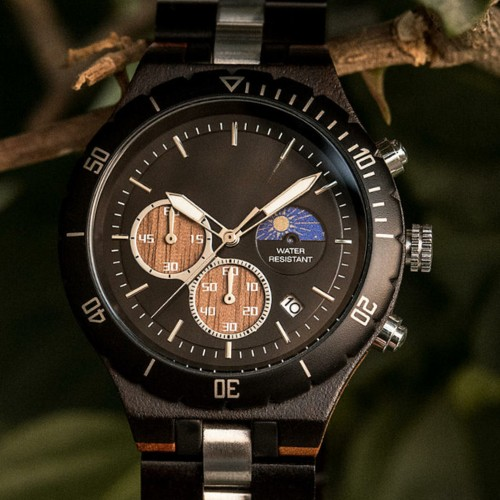
A Watch for Him
Stylish wood watches for men inspired by nature. Our men's fashion watch...
-
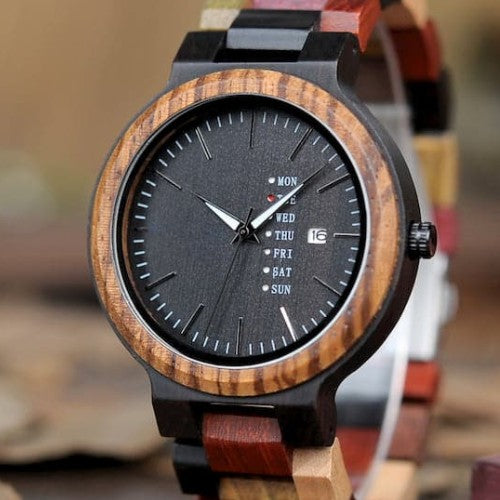
A Watch for Her
Our select women's wooden watches are ideally suited to the Australian lifestyle....
-
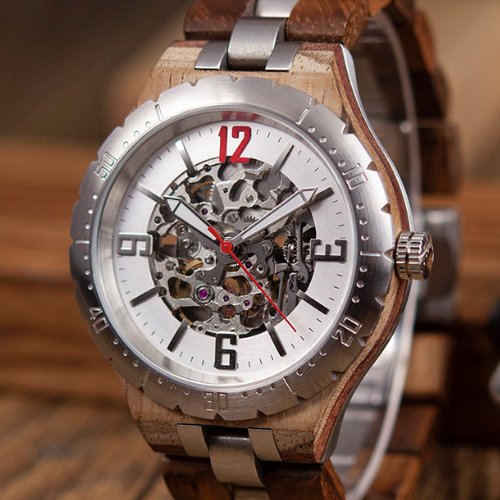
Kinetic Watches
Genuine automatic wood watches for men and women. Also known as self-winding...
-
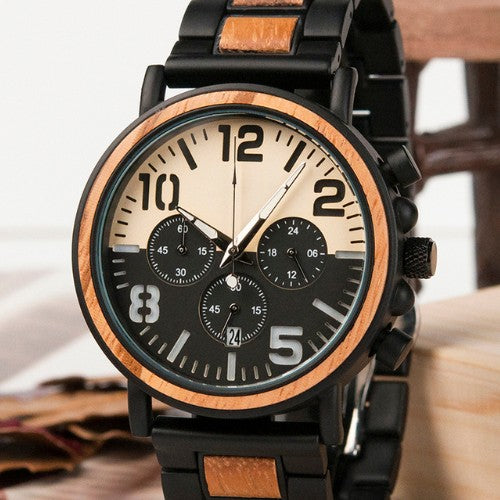
Quartz Watches
Our quartz wood watches use renowned Japanese quartz crystal movement to keep you...
